Case Study
Heathrow Airport
British Airways Fleet Support Unit, Heathrow: Aviation Civil Engineering and Groundworks
When REDS Group was appointed to deliver a major fuelling and infrastructure upgrade at the British Airways Fleet Support Unit at Heathrow Airport, they brought in JMJ Groundworks to carry out civil engineering and groundworks on site.
Our relationship with REDS had started on a smaller project in the Lake District, where we helped decommission a fuel tank and demolish the building housing it. The standard of our work there led to JMJ being recommended for the much larger and more complex Heathrow project.
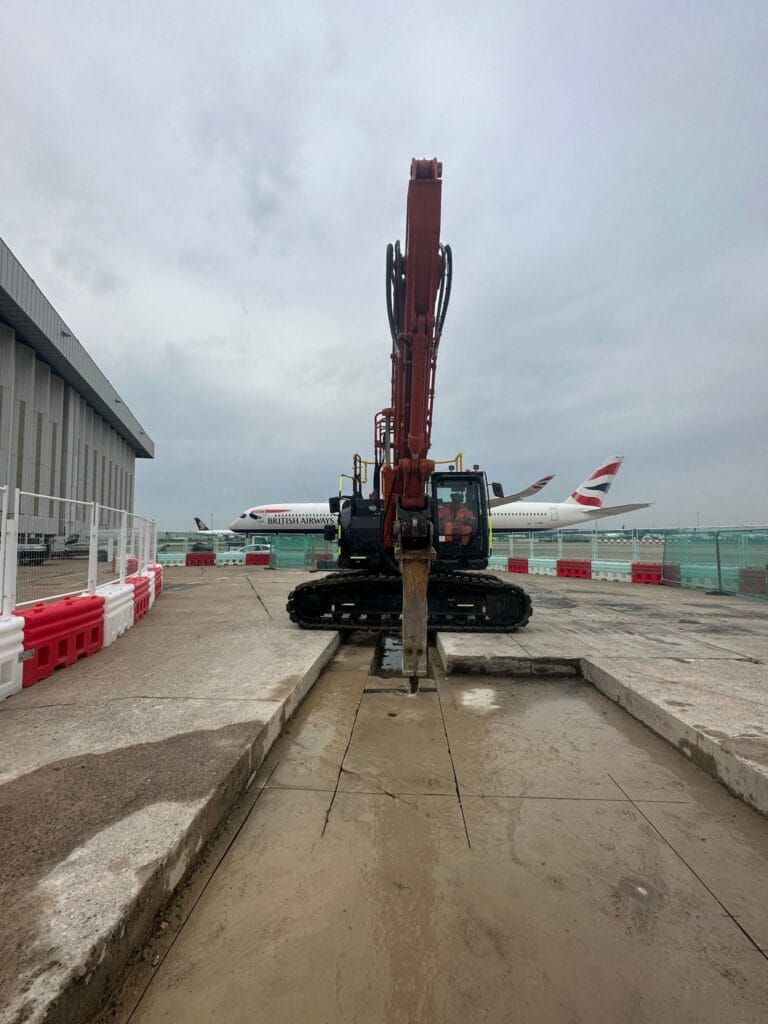
Over a 32-week programme, our four-man team delivered the majority of the groundworks and civil engineering on site. That included deep excavations, reinforced concrete, drainage and underground ducting, all carried out inside a live aircraft hangar that British Airways continued to use throughout.
Project Overview
Client
REDS Group for British Airways
Project
Fuelling and infrastructure upgrade, BA Fleet Support Unit
Location
Heathrow Airport, London
Duration
32 Weeks
Services
Civil engineering and groundworks: excavation, reinforced concrete, drainage, ducting and temporary works
Scope of Work
REDS delivered the overall specialist fuelling installation, with the mechanical, electrical and fuel system works carried out by REDS and specialist contractors. JMJ provided a labour-only civils and groundworks package, with four operatives on site for the full programme.
Our works covered:
- Groundworks and excavation
- Concrete breakout and demolition
- Formwork and reinforced concrete construction
- Drainage excavation and installation
- Construction of drainage chambers
- Excavation and civils for a new oil/water interceptor
- Assisting with lifting and positioning tanks and infrastructure
- Trenching for new services and installing underground ducting
- Construction of a below-ground nose pit
- Temporary works for the excavations
- Concrete reinstatement
- Kerbing around the new fuelling stations
The project included more than 55 metres of drainage trench, four new access chambers and substantial reinforced concrete construction, with concrete up to around 800mm thick in places. We also built a new below-ground nose pit, roughly 2.5m × 5m × 2.5m deep, along with the underground ducting for the new aircraft power infrastructure.
Project Challenges
Working inside an operational aircraft hangar
This was unlike anything JMJ had done before. British Airways needed to keep using the facility throughout construction, so around half of the hangar had to remain open and accessible at all times, with aircraft continuing to move in and out alongside our works.
Every element of our programme had to be coordinated around aircraft movements and BA’s operational needs. Excavations, concrete pours, deliveries, temporary works and working areas were all planned to keep safe access clear and make sure our activities never interfered with the running of the hangar.
Heathrow security and access controls
Working airside at Heathrow meant operating within strict security, permit and access procedures, including being escorted in and out of restricted areas. Our team adapted to these controls from day one and kept productivity high within them.
Deep excavations and groundwater
The depth of the nose pit, the volume of reinforced concrete and the network of underground services meant excavation support and temporary works had to be carefully considered throughout. High groundwater around the new oil/water interceptor required a significant excavation and a dedicated temporary works solution to carry out the work safely.
Delivery
Our team turned the designs into completed infrastructure, working closely with REDS and their specialist teams as the mechanical, electrical and fuelling systems were installed around our works.
We kept the same four operatives on site for the full 32 weeks. That consistency mattered in an environment like Heathrow, where knowing the site, the procedures and the people makes a real difference to safety and progress. We delivered our civils and groundworks element in step with the wider programme while the hangar stayed operational.
Results
JMJ successfully delivered the civils and groundworks element of the project alongside REDS, completing the full 32-week programme at Heathrow.
For a four-man team, it was a substantial package, and it proved our ability to work effectively in a highly controlled, safety-critical commercial environment, adapting our programme around a live airport and aircraft maintenance facility.
It also marked an important stage in our relationship with REDS Group. Following our performance at Heathrow, REDS have continued to appoint JMJ on further aviation projects, including works at Newquay Airport and Bristol Airport.
For us, the Heathrow project shows the versatility of our teams. The same core groundworks skills we use on housing and commercial developments across Devon and the South West can be applied to far more complex civil engineering environments, with the right planning, supervision and coordination with specialist contractors.
Project Gallery
Need Civil Engineering or groundworks support?
Whether you’re managing a multi-phase development or a one-off infrastructure upgrade, we’re ready to help.